Le lingue pluricentriche: il caso dell’italiano

Pluricentric Languages in Africa and in Other Regions of the World
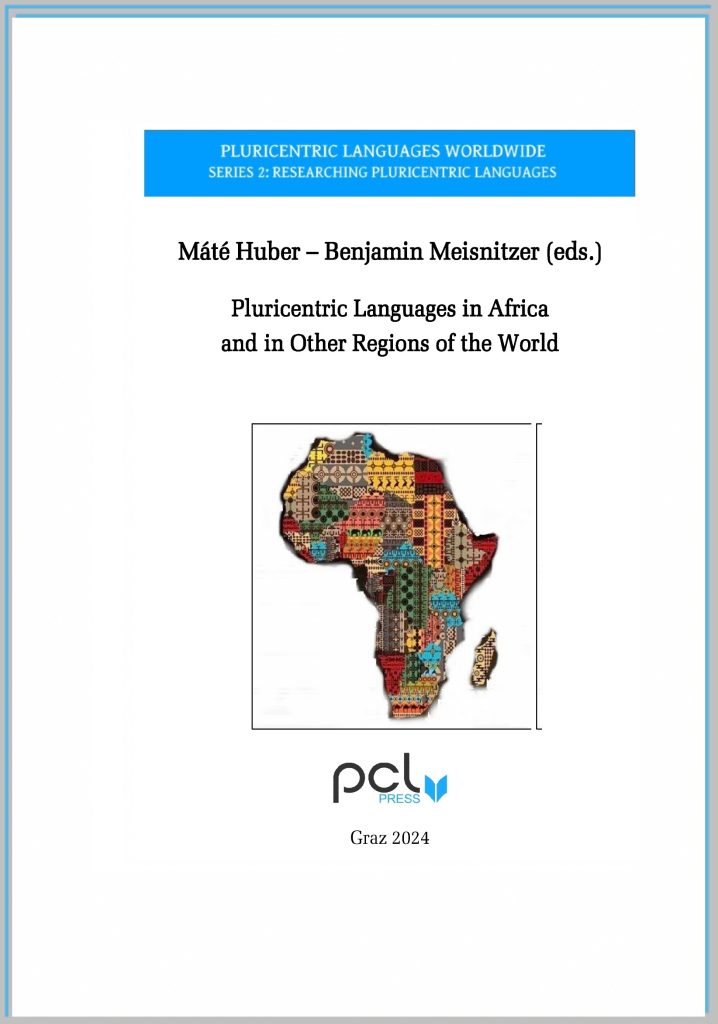
This volume contains the proceedings of the 10th International Conference on Pluricentric Languages and their Non-Dominant Varieties. It comprises papers that discuss several pluricentric languages and their non-dominant varieties from different regions of the world, much in keeping with the diverse range of topics that were presented at the online conference that was hosted by the University of Leipzig on August 23-24, 2023. As the subtitle of the conference was Pluricentric Languages, Multilingualism, and Linguistic Dehegemonisation in Africa, the primary focus of the volume is also on pluricentric languages in a highly diverse, multilingual African context. The contributions in the second part of the volume (i.e. the final five papers) are concerned with topics that are related to pluricentric languages and their non-dominant varieties in other areas of the world, such as the Americas, Europe, and the Middle East.
A língua Portuguesa falada em Timor-Leste: Um estudo ecolinguístico
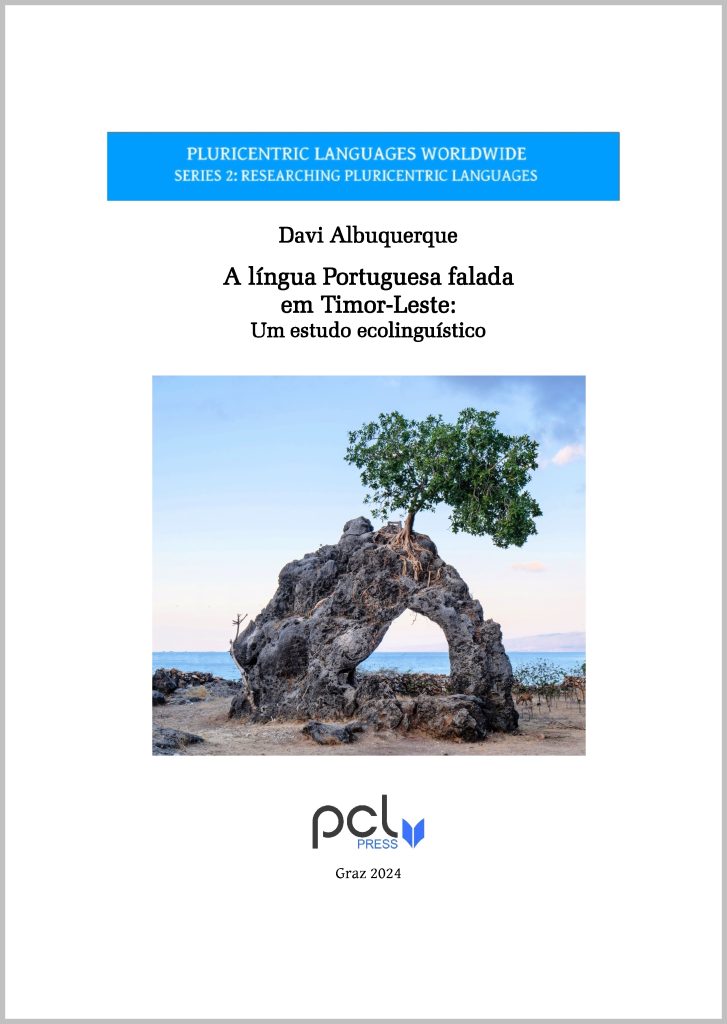
Portuguese is the official language of the Democratic Republic of East Timor, alongside Tetun Prasa (an Austronesian language and local lingua franca). In this work, I carry out a study of the Portuguese spoken in East Timor in order to verify whether it is possible to recognize a variety of Portuguese in formation. Other objectives include its documentation and description of its most notable linguistic aspects, as well as to develop actions to value it inside and outside East Timorese society in latter moments of the investigation. In order to achieve the objectives, I use Ecolinguistic theory and its different methods of analysis, which cover linguistic and extralinguistic topics, so that it is possible to describe accurately the Portuguese language in Timor, approaching several aspects of the researched object. It is emphasized here that a position of preserving the (possible) variety of the Portuguese language spoken in East Timor is also an ecological stance since it is aiming to maintain the linguistic diversity of the Portuguese language in the world.
A History of Language-learning among the Muslims of South Asia
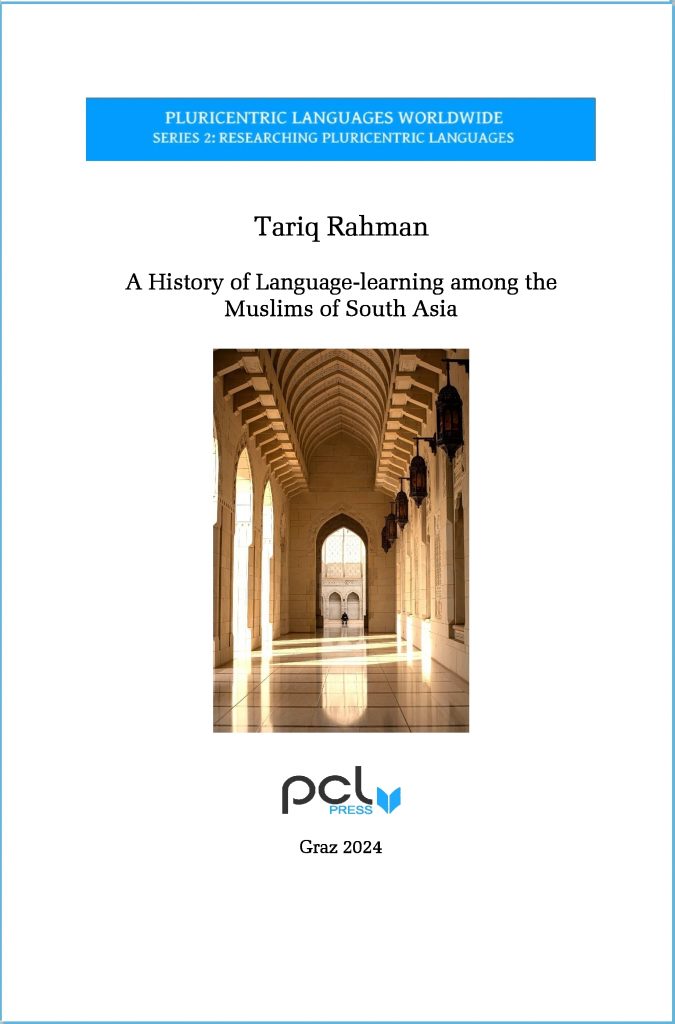
This is the first book-length study of the history of language teaching and learning among South Asia Muslims. It traces the history of language¬ teaching among the Muslims of north India and present-day Pakistan, and then relates language-learning (the demand) and teaching (the supply) to ideology (or world view) and power. It makes the point that the Muslims in this part of the world, like other people elsewhere, learned languages to empower themselves by acquiring marketable linguistic skills at all periods of history. It also argues that those who determine what languages and what textbooks are to be taught, would like and are in a position to promote the ideology which, in their opinion, promotes or consolidates their own power, or maintains the status quo. In short, the teaching and learning of languages is linked to the distribution of power which, in turn, is connected to employment, promotion of certain ideologies, shaping of identities, and national interest.
„One size fits all“? Linguistic standards in the media of pluricentric language areas

Sociolinguists are studying language use in all kinds of spoken, written, and audiovisual media. Similarly, language attitude towards language use, and also the impact of media on language change is investigated. Some of these media are scripted and professionally produced, such as news broadcasts, dubbed films, and podcasts, while other media, like video blogs or posts on social media, are not necessarily. Media creators often, but not always, adhere to linguistic guidelines or language policies. They may also, sometimes without knowing it, follow certain established linguistic practices, or deliberately challenge these. In pluricentric language areas, when language is used in the media, decisions are often made in terms of which language variety to use. Such decisions usually take into consideration the main target audience. Sometimes an attempt is made to use a so-called “neutral variety”, unmarked for any specific part of the language area, to cater to the larger language area as a whole. This one-size-fits-all approach, however, is challenged by glocalisation tendencies and calls for more linguistic diversity. Moreover, the Age of Streaming opened up new possibilities with several language versions that can be offered on demand (including media accessibility). Dutch-language audiobooks, for instance, can sometimes be streamed in a Belgian and a Netherlandic Dutch version. Likewise, some audiovisual fiction for children is available in a Belgian and Netherlandic Dutch dubbed version on streaming platforms.
Language and Politics in Pakistan

Pakistan has had many conflicts involving language. Relying on primary sources, Rahman has written a scholarly and objective account of the link between language and politics in Pakistan.
Pakistani English – The Linguistic Description of a Non-Native Variety of English

This study began life as an M.Litt thesis at the University of Strathclyde, Glasgow in 1989. As I broke my arm when I was just about to begin writing it the actual writing in longhand was done by my wife Rehana Rahman. I used to dictate the book to her and she used to write it in our flat in beautiful Cumbernauld. I do not quite remember just how she drew the diagrams but I did some sketching with the left hand and she must have refined it for the person who word-processed it on the computer. I thank her for this and for looking after all of us during that difficult period.
When I returned to Pakistan and joined the National Institute of Pakistan Studies, Quaid-i-Azam University, the director of the Institute, Professor Fateh Mohammad Malik asked me to get this book published. So, this book was first published in the NIPS monograph series in 1990. Out of the three monographs published in that year only this one was sold out in a few years because it was relevant to the new discipline of English Language Teaching (ELT) which had emerged in Pakistan in the late eighties and early nineties. A slightly revised version was reprinted in 2009 when I myself was the director of NIPS. As there was no comparable description of Pakistani English (PE) photocopies of the book were used by students all over Pakistan.
Now, the PCL-Press in Graz, Austria, has kindly agreed to publish it. I am highly grateful to Professor Rudolf Muhr of the University of Graz for having encouraged me to submit the manuscript for consideration of the editorial board of the press. This will make the book available to readers across the world and especially to European ones.
I hope this study helps to dispel the popular notions about Pakistani English in Pakistan. These notions appear to be that this is not a variety of Eng-lish but just a mass of ignorant errors which must not be encouraged. I am sure I would have persisted in this view myself if I had not come across Dr. Robert J. Baumgardner’s pioneering articles on Pakistani English. I, therefore, end with compliments to Baumgardner upon whose work I seek to build the foundations of a serious academic analysis and description of Pakistani English. I should add here that this work is of the late 1980s and work on non-native varieties of English has gone far beyond this pioneering attempt of an M.Phil student in 1988-89. The minor revisions I have made do not take all this work into ac-count. The value of this book then, such as it is, is simply to make a work which has historical significance because of its pioneering nature, available to stu-dents in this field. While they may themselves have progressed far more in such kind of studies, such endeavours—incomplete, flawed and even erroneous at places—are the stepping stones upon which their far grander edifices have been erected. It is, thus, with a sense of humility that I offer this work to read-ers far more knowledgeable and sophisticated than I was in 1989 when I worked on it in Scotland.
I take this opportunity to thank all those who saw it through the
PCL-Press. As always, the faults in the book are entirely mine.
Tariq Rahman Ph.D, D. Litt (Sheffield, U.K).
Distinguished National Professor and Dean,
Beaconhouse National University,
Lahore.
14 February 2022
Pluricentric Languages in the Americas

This is the first of two volumes that present part of the outcome 9th World Conference on Pluricentric Languages that took place from August 26-28 2021. The volume contains fourteen contributions. The conference was organised by the “Working Group on Non-Dominant Varieties of Pluricentric Languages” (WGNDV), this time hosted by the Austrian German Research Centre in Graz. Due to the pandemic, the conference was held online via ZOOM much to the satisfaction of all participants. The conference had three main topics: (1) Pluricentric languages in the Americas; (2) The localisation of global audiovisual and print media in pluricentric language ar-eas. (3) Pluricentric languages worldwide. The papers of this volume refer to topic (1) while the papers of theme (3) are published in volume (2).
All articles of this volume deal with pluricentric languages that exist in the Americas. It is the first volume of this kind that has been ever published on this topic. There are papers dealing with the indigenous language Quechua and the Guarani-Tupi language family. Spanish and Portuguese as well as Dutch and Arcadian French in Canada are also dealt with.
From Hindi to Urdu. A Social and Political History

This book is the first of its kind on the socio-political history of Urdu. It analyses the historiography of the language — narratives about its names, linguistic ancestry, place of birth — and relates it to the politics of identity-construction among the Hindus and Muslims of India during the last two centuries. More importantly, a historical account of the use of Urdu in social domains such as employment, education, printing and publishing, radio, films, and television etc. has been provided for the first time. These accounts are related to the expression of Hindu and Muslim identity-politics during the last two centuries.
Evolution of Urdu from the language of the laity, both Hindus and Muslims, of the Indian subcontinent during the period between 15th—18th centuries to its standardization into two languages: Persianized Urdu and Sanskritized Hindi are highlighted here. The writer looks at narratives of the names, theories of genealogy, and places of origin of the language in relation to the political imperatives of identity-politics of Hindus and Muslims during the nineteenth and twentieth centuries. In a nutshell, historiography is analyzed with reference to its political and ideological dimensions—and a fresh analysis regarding the linguistic history of Urdu is provided.