
Non-dominant Varieties of pluricentric Languages Getting the Picture. In memory of Michael Clyne.
edited by Rudolf Muhr
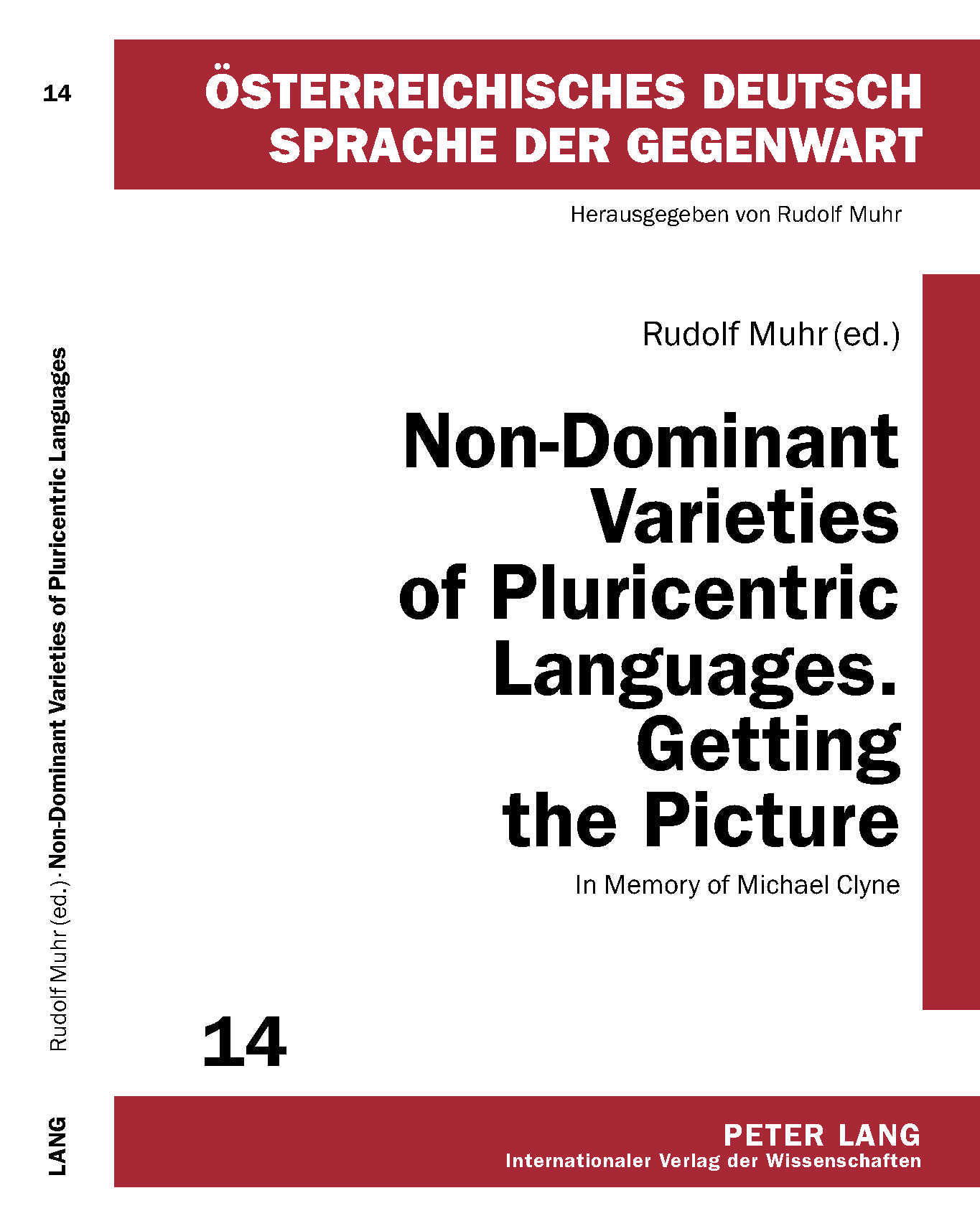
Pluricentric languages worldwide, non-dominant varieties, typology of different non-dominant varieties, problems of codification and status planning, difficulties in status gain, common characteristics of non-dominant varieties, non-dominance in Armenian, Arabic, German, English, Dutch, Portuguese, Chinese, Hindi, Italian, French etc.
Language(s) dealt with: English
Details
published by Peter Lang Verlag (Wien/Frankfurt et. al.)
September 3, 2012 | 498 pages | ISBN 978-3-653-01621-5; DOI: https://doi.org/10.3726/978-3-653-01621-5
Preface
This volume comprises 28 papers that were presented at the “1st International Conference on Non-Dominant Varieties of Pluricentric Languages” which was organised by the “Working Group on Non-Dominant Varieties of Pluricentric Languages” and held in Graz (Austria) from July 11-13, 2011. The conference was also held in memory of Michael Clyne – eminent linguist, scholar, teacher, language enthusiast, advocate of multilingualism and friend who died on October 29, 2010.
The volume is a tribute to his important contributions in many fields of linguistics, especially in sociolinguistics, pragmatics, bilingualism and multilingualism and in the theory of pluricentric languages. It was his seminal anthology on 19 pluricentric languages, published in 1992, that introduced the distinction between dominant and non-dominant varieties of pluricentric languages. John Hajek – his successor as director of the “Research Unit for Multilingualism & Cross Cultural Communication (RUMACCC) – contributed a moving homage to Michael Clyne to this volume which gives an account of Michael’s outstanding achievements. The conference in Graz was the first international event to document the situation of non-dominant varieties world–wide in order to identify common or diverging features. It allowed us to gain initial insights into the codification and corpus and status planning of non-dominant varieties. At the same time, the scope and quality of the papers presented at the conference encouraged us to plan further conferences on the topic, starting with the second conference in Salamanca in 2012. My associate editors and I would like to thank the scholars taking part in the conference. The papers of this volume fall into 7 thematic sections:
(1) Defining dominance and non-dominance in pluricentric languages and exploring their effects on linguistic theory; (2) Non-dominance of varieties and languages in historical periods and in the context of special language; (3) Non-dominant varieties that successfully improved their status; (4) Non-dominant varieties of languages where the status of the variety is unclear, evolving or changing; (5) The effects of pluricentricity in the Portuguese-speaking world; (6) Dominance and non-dominance in the Arabic-speaking world in the context of diglossia and multilingualism; (7) Dominance and non-dominance of pluricentric languages in multilingual societies in Africa, India and Asia.
The papers treat a wide range of topics connected with the concept of dominance and non-dominance in pluricentric languages and the implications on their varieties and speakers. The volume deals with 18 languages and 31 different national and other varieties in 29 countries of the world: Egyptian Arabic, Kuwaiti Arabic, Moroccan Arabic, Eastern Armenian, Western Armenian, Belgian Dutch, Australian English, Cameroon English, Catalan, Nigerian English, Moroccan French, Frisian (Friisk), Austrian German, Low German (Plattdüütsch), Cypriot Greek, Bhojpuri Hindi, Chinese Hokkien, Occitan in four countries, Italian Italian, Swiss Italian, South Jutish (Sønderjysk), Brazilian Portuguese, Madeiran Portuguese, Mozambique Portuguese, Belarusian Russian, Ukrainian Russian, Canal Sur and Sevillian Spanish, Castilian Spanish, Valencian Catalan, Finnish Swedish and Swedish Swedish. As editor, it is my hope that the results presented here will find a large number of readers and stimulate further research. This hope is shared by the coorganisers of the conference who also assisted in editing this volume, as well as the authors of this volume and the members of the “Working Group on Non- Dominant Varieties of Pluricentric Languages” who would like to invite other scholars to take part in their work.
My sincere thanks go to Catrin Norrby (Stockholm, SE), Leo Kretzenbacher (Melbourne, AU) and Carla Amorós Negre (Salamanca, ES) for their great help and engagement in organizing the conference, in reviewing the draft papers and generally for their support and encouragement. My thanks also go to Dawn Marley (Guildford, UK) and Nils Langer (Bristol, UK) who acted as reviewers and to Naomi Havencroft who helped with the proofreading.
Rudolf Muhr Graz, December 2011